Broadcast Monitoring by the Government of Canada - Annual Survey Instrument
Archived information
Archived information is provided for reference, research or recordkeeping purposes. It is not subject à to the Government of Canada Web Standards and has not been altered or updated since it was archived. Please contact us to request a format other than those available.
The Government of Canada, represented by the Treasury Board of Canada Secretariat (TBS), and the Canadian Broadcasters Rights Agency (CBRA) have concluded a licence agreement regarding the use of the content of CBRA-member broadcasts by Government of Canada institutions. This licence requires that:
- the Government of Canada provide information about each CBRA signal monitored in the form of a compilation of the recording/monitoring schedules organized by signal;
- a list showing the call letters and network affiliation of each signal monitored;
- the royalty attributable to each CBRA signal;
- conduct an annual survey designed to establish the Gross Monitoring Costs (GMC) incurred by institutions that fix CBRA broadcast signals and/or record or excerpt CBRA programs, and
- use the results of this survey, which is to be conducted in October each year, to determine the royalty payable to the CBRA.
Methodology
Participating institutions
The pool of institutions in which the Annual Survey is to be conducted is defined by Government of Canada institutions participating as Electronic Media Monitoring (EMM) program users (and any other institution known or reasonably believed to be monitoring CBRA programs or signals). A list of EMM program users, last updated in February 2005, identifies 78 institutions, many of which participated in previous surveys.
Institutional contact person
The Head of Communications in each of the above referenced institutions will name a person in the media monitoring unit who will:
- be invited to attend information sessions as required;
- be expected to provide the information required, and
- serve as the focal point for collecting and reporting GMC related data.
Information session
Participants will be notified of an information session which will be held for the purpose of:
- distributing a summary of the data collected in earlier surveys, e.g., data collected during the November 2003 and January 2005 surveys to the representative of each institution;
- providing a copy of the Annual Survey Instrument;
- providing a blank copy of each data collection instrument that is to be used in the Annual Survey;
- describing the nature of the tasks to be fulfilled;
- indicating when the Survey will begin and end,
- providing information about the terms and conditions of the licence;
- indicating that completed data collection instruments must be delivered to the researcher by the end of the second week following the survey period, and
- answering questions.
Data collection instruments
The form and content of the data collection instruments used in this survey evolved as a result of experience and feedback obtained from the institutions that participated in earlier surveys.
A brief description of each instrument-the Program Monitoring Log, the Monitoring Personnel Record, the Capital Expenditure Record, Operating Expense Record and the Limited Electronic Format Record-follows.
The Program Monitoring Log, found at Appendix A, is used to identify:
- the call letters of every broadcast signal monitored during the survey period;
- network affiliation of every broadcast signal; and
- the monitoring schedule for every broadcast signal.
For example:
If the program monitored is Canada AM, which is broadcast Monday through Friday on CJOH, a member of the CTV Network, from 6:30 a.m. to 8:30 a.m. one would record this monitoring schedule as shown below.
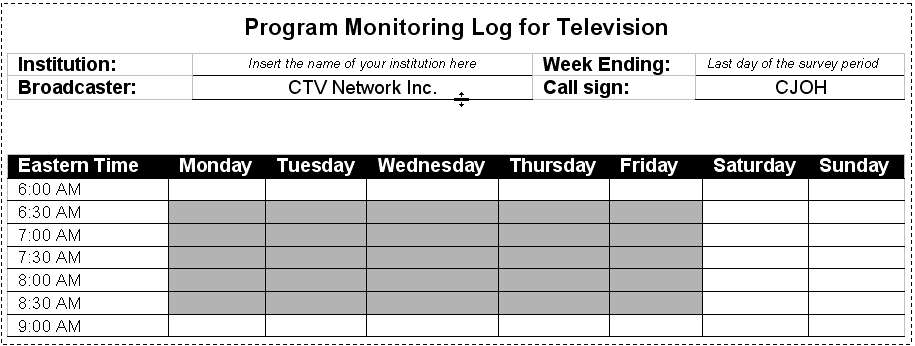
Program Monitoring Log for Television - Text versions
A similar procedure would be followed when completing the Program Monitoring Log for Radio.
The Monitoring Personnel Record, found at Appendix B, is used to record information about the position and employment classification (Group and Level) of:
- all staff and managers directly or significantly involved in the monitoring of radio and/or television broadcasts;
- those who provide excerpts, transcripts and summary notes based on that material to users within the institution, and
- the proportion of time each individual spends monitoring radio and/or television broadcasts.
For example:
After inserting the name of the institution and the date of the last day in the survey period in the places provided, one would insert the title and classification of the position occupied by persons involved in the monitoring of radio and television broadcasts and the proportion of time each spends monitoring and working with the radio and television broadcasts. A completed form would look like what is shown below.
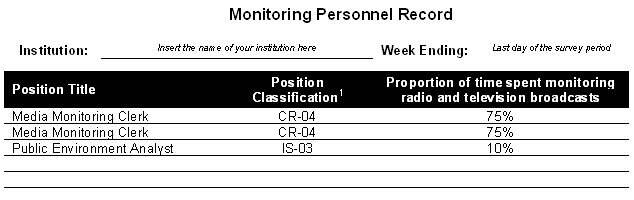
Institutions are to use the Capital Expenditure Record, found at Appendix C, to identify the capital expenditures associated with the monitoring of radio and television broadcasts. These include:
- the type of equipment purchased-including such items as computers, video-recorders and other equipment;
- the cost of the equipment, and
- the date on which each piece was acquired.
For example:
After inserting the name of the institution and the date of the last day in the survey period in the places provided, one would insert a description of the item purchased, its cost and the date it was acquired in the places provided.
A completed record would look like what is shown below.
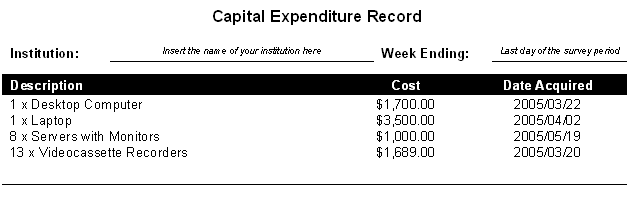
The first part of the Operating Expense Record, found at Appendix D, is used to record operating expenses incurred while monitoring broadcast signals. These include:
- the type of item equipment leased, software licences bought, office supplies, and telephone and network charges;
- the cost of each item.
For example:
After inserting the name of the institution and the date of the last day in the survey period in the places provided, one would insert a description of the item leased, rented or purchased, its cost and the date it was acquired in the places provided. A completed form would look like what is shown below.
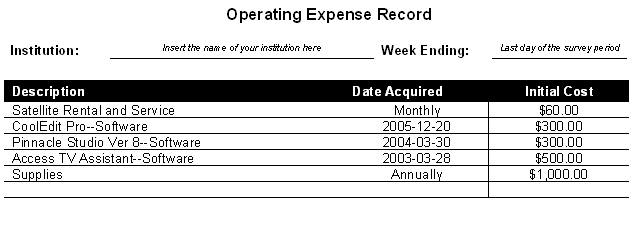
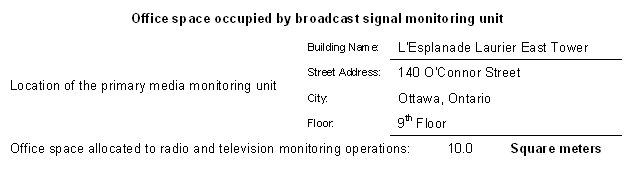
In the second part of the Operating Expense Record an institution is expected to record details of the space occupied by the broadcast monitoring unit. It requires that institutions report the:
- building name or street and city address;
- the floor on which the broadcast monitoring unit is located; and,
- number of square meters allocated to monitoring broadcast signals.
A completed record would look like what is shown below.
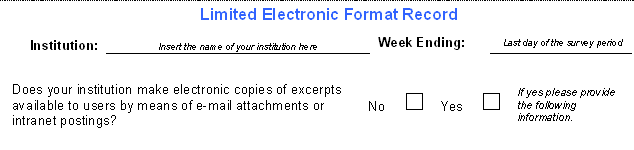
Institutions are to use the Limited Electronic Format Record, found at Appendix E, to indicate the specifications used in making electronic copies of Excerpts available to users.
The licence specifies that institutions may make electronic copies of Excerpts available to users by means of an e-mail attachment or institutional intranet posting in Limited Electronic Format only. This format is defined as having a resolution no greater than 352 x 288 pixels and a frame rate no greater than 12 frames per second.
As with the other forms, the first step in completing the Limited Electronic Format Record would be to record the name of the institution and the period to which the completed form applies in the appropriate places.
The second step is to indicate whether electronic copies of Excerpts are made available to users by means of e-mail attachments or intranet postings. A check mark placed in the No box would complete this Record, while a check mark placed in the Yes box requires that additional information be provided.
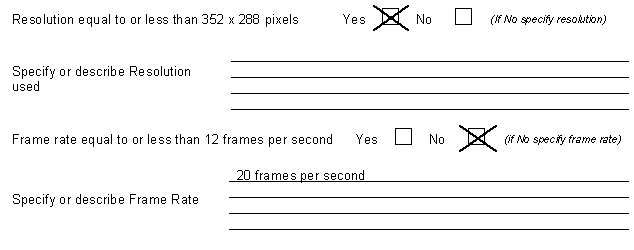
If the answer to the question is "Yes" the institution must specify the resolution and the frame rate used in making electronic excerpts available to users by completing the following portion of the record.
For example:
An institution that reproduces electronic excerpts with a resolution of 352 x 288 pixels with a frame rate of 20 fps would complete the form as shown below.
Data collection timeline
Survey Week
During the week designated as the Survey Week the institutional representative is to complete the Program Monitoring Log for each radio and television station monitored and the space allocation portion of the Operating Expense Record should be completed in the manner described above.
In addition, the data required to complete the Limited Electronic Format Record, Capital Expenditure Record, Operating Expense Record and the Limited Electronic Format Record should be retrieved from the financial information and other systems that serve the media monitoring unit. This information is to be recorded on the respective forms in the manner shown.
First week after Survey Week
Since it is possible that the retrieval of financial information may pose some interesting challenges, some delay is to be expected. Therefore, the first week after Survey Week is to be considered as a grace period.
Second week after Survey Week
During this week each institutional representative will be called for the purpose of obtaining a progress report. It is during this conversation that the researcher will determine whether there could be a problem obtaining the required information from an institution. Attempts at resolving such problems must be made.
Third week after Survey Week
It is expected that by Wednesday of the third week after Survey Week all institutions will have completed all of the data collection instruments and by close of business on Friday will have forwarded the completed documents to the researcher.
Fourth week after Survey Week
In the fourth week after Survey Week the researcher will contact the institutional representative for institutions that have not submitted completed records to remind him or her that the deadline for submitting completed data collection instruments has passed.
Should it become apparent that an institution will not complete the instruments by the close of business on Friday of the fourth week after Survey Week the researcher must institute the procedure for the treatment of missing data. The first step in this procedure is to use the Government of Canada Population Affiliation Report1 to determine the number of employees in each institution. The researcher will use these numbers to classify institutions as small, medium or large.
Data compilation and analysis
Missing Data
In instances where there is missing data an adjusted data set must be generated. The data for institutions in the same classification as the one for which data is missing will be averaged and this average substituted for the missing data.
Data Correction
As indicated in the licence, this data set will be modified to prevent inappropriate disclosure of expenditures made by institutions engaged in law enforcement, national security and emergency operations activities. This will be achieved by adding the expenditures on Capital; Personnel; Operating; and Rent for the
- Canadian Security and Intelligence Services;
- Office of Critical Infrastructure Protection and Emergency Preparedness, and
- Royal Canadian Mounted Police
together to form single entries that will be reported for an institution known simply as "Policing, Security and Emergency Operations".
Data Compilation
Finally, the expenditures identified for the four GMC components-Capital; Personnel; Operating, and Rent-for each institution in which the survey was conducted will be added together to determine the GMC for the Government of Canada.
The royalty payable will then be determined in accordance with the licence.
Any change to the data collection instruments described herein must be reviewed and approved by the CBRA before data collection may begin. Furthermore, the results of the survey must be reviewed approved by the CBRA.
Questions
Should additional information or answers to questions be required, please contact the following:
Gary Warnock
Director,
Corporate Identity and Communications Policy
Treasury Board of Canada, Secretariat
140 O'Connor Street, 10th Floor
Ottawa, Ontario K1A 0R5
Telephone (613) 952-3963
e-mail warnock.gary@tbs-sct.gc.ca
- Date modified: