

ARCHIVED - Canadian Heritage
 This page has been archived.
Archived Content
Information identified as archived on the Web is for reference, research or recordkeeping purposes. It has not been altered or updated after the date of archiving. Web pages that are archived on the Web are not subject to the Government of Canada Web Standards. As per the Communications Policy of the Government of Canada, you can request alternate formats on the "Contact Us" page.
2009-10
Report on Plans and Priorities
Canadian Heritage
The original version was signed by
The Honourable James Moore, P.C., M.P.
Minister of Canadian Heritage and Official Languages
Table of Contents
SECTION I – Departmental Overview
- Raison d’être
- Responsibilities
- Strategic Outcomes
- Program Activity Architecture (PAA)
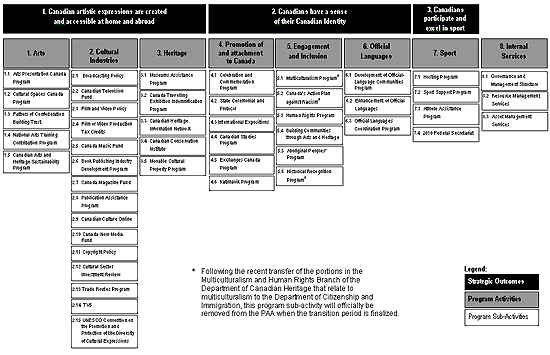
- 2009–2010 Program Activity Architecture
- PAA Crosswalk
- Financial Resources
- Human Resources
- Budget 2009
- Expenditure Profile
- Contribution of Priorities to Strategic Outcomes
- Risk Analysis
- Voted and Statutory Items
SECTION II – Analysis of Program Activities by Strategic Outcomes
- Program Activity 4: Promotion of and Attachment to Canada
- Program Activity 5: Engagement and Inclusion
- Program Activity 6: Official Languages
SECTION III – Supplementary Information
List of Tables
Other Items of Interest
Minister's Message

As Minister of Canadian Heritage and Official Languages, I present the Department of Canadian Heritage’s 2009–2010 Report on Plans and Priorities. This report builds on the Department’s progress in revising its structure to report on how it manages and allocates resources to its many programs and activities. The implementation of new reporting tools will
reinforce accountability and transparency in program management and delivery.
As the 2009 Budget indicated, culture reflects who we are as a nation, how we see ourselves as citizens, and how we present ourselves to the world. Every day in every part of the country, Canadians experience our rich and diverse cultural heritage through the works of our incredibly talented artists. With this budget, the Government is recognizing the significant contribution the
cultural sector makes in stimulating and strengthening our economy. We are highlighting the importance of our artistic institutions, supporting training for the next generation of artists, and investing directly in our communities.
This Report does not reflect the full implementation of the renewal of certain programs or the results of Strategic Review, which are currently being phased in. As such, this document does not completely capture the Government’s commitment to funding levels for arts, culture, heritage and official languages.
In June 2008, the Government of Canada announced the Roadmap for Canada’s Linguistic Duality 2008–2013: Acting for the Future. I am proud of our linguistic duality, a core Canadian value that provides significant benefits for Canadians, at home and abroad. The Roadmap builds on existing commitments and proposes new investments that will allow English and French
minority-language communities to receive services in their own language.
As well, in less than a year from now, Canada will be hosting the 2010 Olympic and Paralympic Winter Games in Vancouver and Whistler. The Games serve as a venue to test the talent of Canada’s athletes and will also provide a unique opportunity to showcase our vibrant and diverse culture to the world. I look forward to working with my colleague, the Honourable Gary Lunn, Minister
of State (Sport), and all the other partners to ensure that the 2010 Games are truly Canada’s Games.
The Honourable James Moore, P.C., M.P.
Summary Information
Raison d’être
The Department of Canadian Heritage and Canada’s major national cultural institutions play a vital role in the cultural, civic and economic life of Canadians. We work together to promote culture, the arts, heritage, official languages, citizenship and participation, Aboriginal, youth, and sport initiatives.
Responsibilities
The Department of Canadian Heritage is responsible for formulating policies and delivering programs that help all Canadians participate in their shared cultural and civic life. The Department’s legislative mandate is set out in the Department of Canadian Heritage Act, which offers an extensive but not exhaustive list of responsibilities for the Minister under the heading of “Canadian identity and values, cultural development, and heritage.”
The Department oversees the administration of a large set of governing legislation, notably: the Broadcasting Act, the Copyright Act (shared with Industry Canada), the Official Languages Act (Part VII), the Museums Act, the Cultural Property Export and Import Act, the Status of the Artist Act, and the Physical Activity and
Sport Act (shared with Health Canada).
The Department of Canadian Heritage is specifically responsible for formulating and implementing cultural policies related to copyright, foreign investment and broadcasting, as well as policies related to arts, heritage, official languages, sports, state ceremonial and protocol, and Canadian symbols. The Department’s main activities involve funding community and other
third-party organizations to promote the benefits of culture, identity, and sport for Canadians. The Minister of Canadian Heritage and Official Languages is accountable to Parliament for the Department and the 19 other organizations that make up the Canadian Heritage Portfolio.
In October 2008, the Minister of Citizenship and Immigration became the Minister of Citizenship, Immigration and Multiculturalism. Consequently, the responsibilities related to multiculturalism were transferred from the Department of Canadian Heritage to Citizenship and Immigration Canada.
Strategic Outcomes
The Department’s work is structured around the following three strategic outcomes:
- Canadian artistic expressions and cultural content are created and accessible at home and abroad – this speaks to the importance of the continued existence and public availability of Canadian cultural products, artistic work by Canadian creators and performers, and Canada’s cultural heritage.
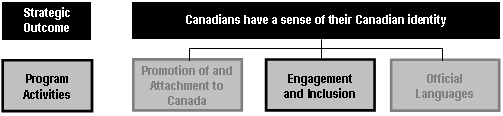
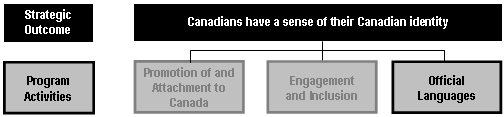
- Canadians have a sense of their Canadian identity – this supports the mandate of fostering a stronger Canadian identity through active, engaged, inclusive citizenship, and the recognition of the importance of both linguistic duality and a shared civic identity.
- Canadians participate and excel in sport – this speaks to the beneficial effects of sport participation on health and to the impact of international achievement in sport on Canadian pride.
Program Activity Architecture (PAA)
The Program Activity Architecture (PAA) serves to provide an overview of how the Department’s programs and activities are linked and how their expected results are organized to contribute to achieving the Department’s Strategic Outcomes and mandate. To accompany the PAA, a Performance Measurement Framework (PMF) was developed and serves as an objective basis for collecting information related to the intended results of the Department’s programs. The 2009–2010 Report on Plans and Priorities is primarily based on the PAA and the expected results and performance indicators identified in the PMF. One area of continued focus for the Department is the establishment of appropriate targets at all levels of the PMF.
For 2009–2010, Canadian Heritage undertook a major review of its PAA with a view to better represent its programs and activities and enhance the management of its resources and the production of its financial and non-financial reports.
The restructuring of the PAA was done in accordance with the Management, Resources and Results Structure Policy and the recommendations from assessments conducted under the Management Accountability Framework. The revised PAA, presented on the following page, provides a more cohesive departmental story.
2009–2010 Program Activity Architecture
PAA Crosswalk
The table below illustrates the redistribution of financial resources by program activity from 2008–2009 to 2009–2010.
| ($ millions) | Arts | Cultural Industries | Heritage | Promotion and Attachment to Canada | Engagement and Inclusion | Official Languages | Sport | Internal Services | Total | |
|---|---|---|---|---|---|---|---|---|---|---|
| 2008–2009 Program Activities |
Creation of Canadian content and performance excellence |
0.4 |
84.7 |
- |
0.1 |
- |
- |
140.0 |
10.1 |
235.3 |
|
Sustainability of cultural expression and participation |
43.8 |
51.8 |
4.2 |
0.1 |
- |
- |
32.2 |
15.5 |
172.0 |
|
|
Preservation of Canada’s Heritage |
0.3 |
1.9 |
11.6 |
- |
21.3 |
- |
- |
6.0 |
41.1 |
|
|
Access to Canada’s Culture |
74.1 |
79.5 |
12.9 |
0.2 |
1.0 |
- |
2.5 |
22.7 |
192.8 |
|
|
Promotion of inter-cultural understanding |
0.1 |
0.5 |
- |
- |
6.3 |
115.2 |
- |
3.2 |
125.4 |
|
|
Community Development and capacity-building |
0.2 |
0.6 |
- |
- |
0.5 |
256.6 |
- |
3.7 |
261.6 |
|
|
Participation in Community and Civic Life |
1.1 |
4.4 |
8.2 |
130.9 |
102.5 |
3.4 |
22.6 |
26.4 |
275.2 |
|
|
Total |
119.9 |
223.4 |
36.8 |
131.3 |
131.7 |
375.2 |
221.7 |
87.7 |
1,303.5 |
Planning Summary
Financial Resources
The financial resources table below provides a summary of the total planned spending for Canadian Heritage for the next three fiscal years.
| 2009-2010 | 2010-2011 | 2011-2012 |
|---|---|---|
| 1,303.5 | 1,062.7 | 1,023.0 |
Human Resources
The human resources table below provides a summary of the total planned human resources for Canadian Heritage for the next three fiscal years.
| 2009-2010 | 2010-2011 | 2011-2012 |
|---|---|---|
| 2,421.5 | 2,151.7 | 2,152.2 |
Budget 2009
Budget 2009: Canada's Economic Action Plan announced new investments that will have an impact on the resources of the Department of Canadian Heritage over the next few years. The Budget announcements are not reflected in the financial information provided in this report. They include:
- targeted two-year funding of $60 million to support infrastructure-related costs for local and community cultural and heritage institutions such as local theatres, libraries and small museums;
- increased funding by $20 million over the next two years and $13 million per year thereafter to the National Arts Training Contribution Program;
- $30 million over the next two years to support continued access to Canadian magazines and community newspapers;
- $28.6 million over the next two years to support new media, and $14.3 million annually thereafter; and
- $200 million over the next two years in funding to the Canadian Television Fund.
Expenditure Profile
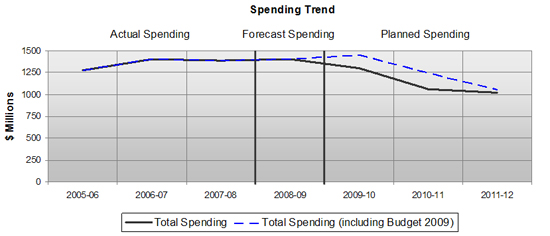
In fiscal year 2004–2005, the departmental spending was $1.264 billion. The increase in actual spending from 2005–2006 to 2006–2007 is mainly due to the increase in funding for the 2010 Olympic and Paralympic Winter Games in Vancouver and Whistler. Between 2006–2007 and 2008–2009, resources remain stable mainly due to the funding of some programs
or initiatives such as the 400th anniversary of Québec City in 2008, the Building Communities through Arts and Heritage program, the official languages support programs, and the federal policy for hosting international sport events.
The reduction of Planned Spending for 2009-2010 (depicted by a solid line in the graphic below) is largely the result of the sunsetting of various programs, including: the Canadian Television Fund, the Canada Music Fund, Cultural Capitals of Canada, and the networking and capacity-building components of the Canadian Arts and Heritage Sustainability Program. It should be
noted that some programs are due for renewal by March 31, 2010 and consequently were not addressed in Budget 2009 and these will be treated in the context of the normal budget planning process in the future.
|
Performance Indicators
|
|---|
| Program Activity1 | Expected Results |
Forecast Spending ($ millions) |
Planned Spending ($ millions) |
Alignment to Gov’t of Canada Outcomes | ||
|---|---|---|---|---|---|---|
| 2008-2009 | 2009-2010 | 2010-2011 | 2011-2012 | |||
| Arts | Canadian artists are prepared for professional artistic careers in Canada and abroad; The sustainability of arts and heritage organizations receiving PCH support is strengthened; Canadians in a variety of communities have access to arts, culture and heritage activities. |
115.5 |
119.9 |
38.7 |
37.1 |
Vibrant Canadian Culture and Heritage |
| Cultural Industries |
A range of Canadian cultural content is created and produced; Canadian cultural industries receiving funding from Canadian Heritage are sustainable; Canadian cultural content is accessible in Canada and abroad. |
336.0 |
223.4 |
177.8 |
170.6 |
Vibrant Canadian Culture and Heritage |
| Heritage |
Heritage institutions and heritage workers have improved their professional knowledge, skills and practices; Heritage collections are preserved by heritage institutions for current and future generations; Canadian and international audiences access content presented by heritage institutions. |
38.1 |
36.8 |
37.0 |
35.4 |
Vibrant Canadian Culture and Heritage |
| Total Planned Spending |
380.2 |
253.4 |
243.1 |
|||
|
Performance Indicators
|
|---|
| Program Activity | Expected Results |
Forecast Spending ($ millions) |
Planned Spending ($ millions) |
Alignment to Government of Canada Outcomes | ||
|---|---|---|---|---|---|---|
| 2008-2009 | 2009-2010 | 2010-2011 | 2011-2012 | |||
| Promotion of and Attachment to Canada |
Knowledge of and appreciation for Canada’s shared values and common interests by Canadians, particularly youth, and by the international community. |
107.2 |
131.3 |
71.2 |
67.4 |
Diverse society that promotes linguistic duality and social inclusion |
| Engagement and Inclusion 2 |
Canadians of various backgrounds, reached with PCH initiatives, are engaged and have the opportunity to participate in social, cultural, political and economic aspects of Canadian life. |
120.5 |
131.7 |
119.3 |
113.4 |
Diverse society that promotes linguistic duality and social inclusion |
| Official Languages |
Canadians recognize and support linguistic duality; Official-language minority communities can live in their language, in their communities. |
364.5 |
375.2 |
363.7 |
348.5 |
Diverse society that promotes linguistic duality and social inclusion |
| Total Planned Spending |
638.3 |
554.3 |
529.3 |
|||
|
Performance Indicators
|
|---|
| Program Activity | Expected Results |
Forecast Spending ($ millions) |
Planned Spending ($ millions) |
Alignment to Government of Canada Outcomes | ||
|---|---|---|---|---|---|---|
| 2008-2009 | 2009-2010 | 2010-2011 | 2011-2012 | |||
| Sport | The sport system provides benefits for Canadians. |
220.3 |
197.3 |
177.9 |
171.3 |
Vibrant Canadian Culture and Heritage |
| Total Planned Spending |
197.3 |
177.9 |
171.3 |
|||
Contribution of Priorities to Strategic Outcomes
| Operational Priorities | Type | Links to Strategic Outcome | Description |
|---|---|---|---|
|
Promote the creation, preservation and dissemination of Canadian cultural content to domestic and international audiences. |
Ongoing |
Strategic Outcome 1 |
This operational priority supports the creation and preservation of Canadian cultural content and artistic works by Canadian creators and performers. It also supports the availability and accessibility of Canadian cultural content and products, both at home and abroad and access to Canada’s cultural heritage. The Department supports this priority through its policies, programs and legislative framework found under program activities 1, 2 and 3. |
|
Promote greater knowledge and understanding of Canada, and increase Canadians’ pride and engagement in our country and its communities. |
Ongoing |
Strategic Outcome 2 |
This operational priority supports the implementation of program activities that foster promotion of and attachment to Canada, through learning about Canada's history and civics, symbols and institutions, and participation in national and international events that celebrate and foster attachment to a strong and vibrant Canadian identity. It also supports ongoing efforts to engage Canadians of various backgrounds in the social, cultural and civic life of their communities and country. The Department supports this priority through its policies, programs and legislative framework found under program activities 4 and 5. |
|
Foster linguistic duality in Canadian society and enhance the development of official language minority communities. |
Ongoing |
Strategic Outcome 2 |
Through partnerships and agreements, this priority fosters the vitality of Canada's English- and French-speaking minority communities and enables them to participate fully in all aspects of Canadian life while enhancing the capacity of minority official language communities to have greater access to quality education and different programs and services in their language in their communities. This priority also promotes a better understanding and appreciation of the benefits of linguistic duality and encourages the public to recognize and support linguistic duality as a fundamental value of Canadian society. The Department supports this priority through its policies, programs and legislative framework found under program activity 6. |
|
Support high performance athletes, opportunities for all Canadians to participate and excel in sport, and the hosting of international sport events and the Canada Games. |
Ongoing |
Strategic Outcome 3 |
This operational priority supports high-performance athletes in national and international sporting events, enhances Canada’s ability to host national and international sporting events, supports the development of excellence in coaching and sports organizations and promotes participation in sports by Canadians of all ages and abilities. The Department supports this priority through its policies, programs and legislative framework found under program activity 7. |
| Management Priorities | Type | Links to Strategic Outcome | Description |
|---|---|---|---|
|
Integration of financial and non-financial information |
Ongoing |
Supports all strategic outcomes. |
This management priority supports the implementation of the Management, Resources and Results Structure policy providing a common government-wide approach to the collection, management and public reporting of financial and non-financial performance information. |
|
Blue Ribbon Panel |
Ongoing |
Supports all strategic outcomes. |
This management priority supports the implementation of the Independent Blue Ribbon Panel’s recommendations to make the delivery of grant and contribution programs more efficient while ensuring greater accountability. |
|
Public Service Renewal |
Ongoing |
Supports all strategic outcomes. |
This management priority supports the Clerk of the Privy Council’s initiative to ensure the federal public service preserves and strengthens its capacity to contribute to Canada’s successes through the provision of effective policy advice and efficient program and service delivery. |
Risk Analysis
The Department of Canadian Heritage delivers its mandate in a vibrant environment characterized by the rapid evolution of the social, economic and technological landscapes. Operating in such a dynamic environment carries both risks and opportunities for the organization.
An increasingly diverse Canadian population, coupled with global connectivity and unprecedented technological change, contributes significantly to the transformation we are witnessing in social and consumer behaviours, civic participation and social cohesion. In this context, the Department of Canadian Heritage is committed to ensuring the programs and services it delivers are both
reflective of the changing environment and relevant to its overall organizational goals and objectives. More than ever, in these difficult economic times, responding effectively to change provides an opportunity to preserve and celebrate Canadian society, culture and identity.
On a day-to-day basis, the Department of Canadian Heritage carries out its mandate – in close collaboration with its various stakeholders – largely through the delivery of grant and contribution programs and, in some instances, via third-party organizations. In an era of increased transparency and accountability particular attention consequently needs to be applied to how
the Department manages its overall performance, tells its performance story and that of its funding recipients, and how policies and programs must evolve to adapt to the rapidly changing global environment. The processes for periodic review, evaluation and renewal of programs constitute key tools in this endeavour.
As with most public service organizations, the Department of Canadian Heritage is also faced with management challenges that influence the development of policies and programs and the elivery of benefits to Canadians. For instance, the Department deals with the ongoing challenge to recruit, develop and retain a workforce that meets the high standards that citizens and taxpayers have the right to expect from the public service. It must ensure that its workforce increasingly reflects the diverse make-up of Canadian society. The Department of Canadian Heritage is committed to providing its employees with a healthy and inclusive workplace rooted in values and ethics.
To address these challenges, the Department of Canadian Heritage has developed a corporate risk profile around five central themes: stewardship of resources; results measurement; human resource management; maintaining relevance in response to change; and information management. These themes are identified as key issues that – if left unmanaged – could hinder the
Department’s ability to deliver its mandate and achieve its expected results.
These challenges are being addressed through several mitigation strategies directed and overseen by the Department’s Executive Management Committee. These strategies are directly linked to the management priorities identified earlier and are supported by the planning highlights outlined for each of the Program Activities discussed in Section II of this report.
Voted and Statutory Items
This table illustrates the way in which Parliament approved resources, and shows the changes in resources derived from supplementary estimates and other authorities, as well as how funds were spent.| Vote # or Statutory Item (S) | Truncated Vote or Statutory Wording | 2008-2009 Main Estimates |
2009-2010 Main Estimates |
|---|---|---|---|
|
1 |
Operating expenditures |
272.2 |
265.7 |
|
5 |
Grants and contributions |
1,088.8 |
959.8 |
|
(S) |
Salaries of Lieutenant-Governors |
1.1 |
1.2 |
|
(S) |
Payments under the Lieutenant-Governors Superannuation Act |
0.6 |
0.6 |
|
(S) |
Supplementary retirement benefits-former Lieutenant-Governors |
0.2 |
0.2 |
|
(S) |
Contributions to employee benefit plans |
28.3 |
26.9 |
|
(S) |
Minister of Canadian Heritage-salary and motor car allowance |
0.1 |
0.1 |
| Total |
1,391.3 |
1,254.4 |
|
1For program activity descriptions, please see Section II of this document or access the Main Estimates online at http://www.tbs-sct.gc.ca/est-pre/estime.asp
2 For this year, resource information attached to the responsibilities related to multiculturalism, including the Multiculturalism Program, Canada’s Action Plan against Racism, and the Historical Recognition Program, are included in Canadian Heritage’s Report on Plans and Priorities. However, for planning information, see the report of Citizenship and Immigration.
SECTION II -Analysis of Program Activities by Strategic Outcome
Strategic Outcome 1
Canadian artistic expressions and cultural content are created and accessible at home and abroad.
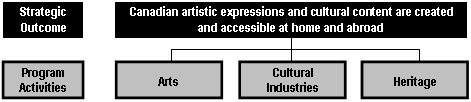
This strategic outcome speaks to the importance placed by the Government of Canada on the continued existence and public availability of Canadian cultural products, artistic work by Canadian creators and performers, and Canada’s cultural heritage. The Government recognizes the significant contribution that the Canadian artistic, cultural and heritage sectors make to our identity and our economy, and that special measures are required to ensure that Canadians have access to Canadian cultural content. The Conference Board of Canada estimates that the cultural sector generated $46 billion in gross domestic product and employed 662,000 people in 2007.
Performance indicators
- Range and volume of Canadian cultural content and artistic works created and produced, by category
- Range of heritage collections, Canadian cultural content and artistic works accessible domestically and internationally, by category
Program Activity 1: Arts
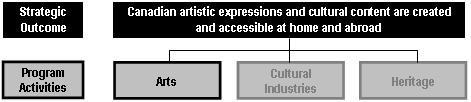
Program Activity Summary
The program activity aims to improve Canadians’ direct access to diverse artistic experiences and to contribute to the sustainability of the arts sector. This is accomplished through funding programs that support the presentation of professional arts festivals or performing arts series, the improvement of arts and heritage infrastructure, the improvement of business and management capacity of arts and heritage organizations that are valued by their community, and institutions that offer training of the highest calibre, in preparation for artistic careers.
|
Sub-activities |
1.1 Arts Presentation Canada Program 1.2 Cultural Spaces Canada Program 1.3 Fathers of Confederation Building Trust 1.4 National Arts Training Contribution Program 1.5 Canadian Arts and Heritage Sustainability Program |
Note: Announcements made in Budget 2009 will fall under this Program Activity. Given that a number of processes must be completed to have the funds allocated, the current planned spending does not reflect the new investments. Please consult page 7 of this report for more information on Budget announcements.
Benefits for Canadians
The arts reflect and define Canada as an accomplished and innovative country, and project a vibrant image of Canada. The arts are at the core of the cultural economy; they contribute to the development of a competitive workforce of creative, knowledgeable workers and industry investors. The arts allow Canadians to embrace their linguistic, ethno-cultural, Aboriginal and regional diversity while strengthening their community identity and pride in Canada and in being Canadian.
Programs and activities in this area help to ensure that Canadian artists are prepared for professional artistic careers in Canada and abroad, that the sustainability of arts and heritage organizations across Canada is strengthened, and that Canadians in a variety of communities across the country have access to cultural infrastructure as well as a diverse range of artistic, culture
and heritage activities.
Planning Highlights
To achieve the expected results, the Department of Canadian Heritage plans to undertake the following activities:
-
The Department will continue to support the arts through arts programs that assist in improving cultural infrastructure, in strengthening the business practices and the sustainability of arts and heritage organizations, in increasing Canadians’ access to the arts in all parts of the country, and in assuring artistic excellence by supporting the training of
Canada’s most promising young artists.
- The Department will help to ensure a strong artistic and cultural presence during the 2010 Olympic and Paralympic Winter Games and the period leading up to the Games. The Cultural Olympiad, the three-year (2008-2010) cultural celebrations of the 2010 Olympic and Paralympic Winter Games, offers an extraordinary opportunity to showcase the excellence, diversity, creativity, and innovation of Canadian artists to both national and global audiences. The Department will assist the Cultural Olympiad in reaching audiences: in the Sea-to-Sky corridor with an extensive and diverse program of cultural events; across Canada through national and regional touring of performing artists featured in the Cultural Olympiad; and around the globe through the Cultural Olympiad Digital Edition (CODE), which will enable audiences at home and abroad to participate in Cultural Olympiad programming via the Internet.
| Performance Measurement Framework | |||||
|---|---|---|---|---|---|
| Expected Results: | Performance Indicators: | ||||
| Canadian artists are prepared for professional artistic careers in Canada and abroad. | Percentage of graduates from funded institutions who are working professionally in Canada and abroad. | ||||
| The sustainability of arts and heritage organizations receiving support from the Department is strengthened. | Number of funding sources of arts and heritage organizations, by type. | ||||
| Canadians in a variety of communities have access to arts, culture and heritage activities. | Number of communities reached, by geographic location and type (type means: rural, remote or urban). | ||||
| Financial Resources ($ millions) | Human Resources (Full-time Equivalents) | ||||
|
2009-2010 |
2010-2011 |
2011-2012 |
2009-2010 |
2010-2011 |
2011-2012 |
|
119.9 |
38.7 |
37.1 |
191.8 |
101.3 |
101.3 |
PROGRAM ACTIVITY 2: CULTURAL INDUSTRIES
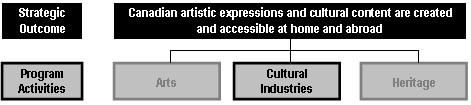
Program Activity Summary
This program activity supports the Canadian cultural sector to ensure that a range of Canadian cultural content is produced and is accessible to domestic and international audiences. It also creates conditions that foster sustainability of the Canadian cultural industries. This program activity aims to enable Canadian creators, entrepreneurs, cultural exporters, producers and cultural industries to develop, market and export Canadian cultural content. This is achieved through delivering programs and services in the form of grants, contributions, tax credits, and policies, regulatory and legislative measures.
Note: Announcements made in Budget 2009 will fall under this Program Activity. Given that a number of processes must be completed to have the funds allocated, the current planned spending does not reflect the new investments. Please consult page 7 of this report for more information on Budget announcements.
|
Sub-activities |
2.1 Broadcasting Policy 2.2 Canadian Television Fund 2.3 Film and Video Policy 2.4 Film or Video Production Tax Credit 2.5 Canada Music Fund 2.6 Book Publishing Industry Development Program 2.7 Canada Magazine Fund 2.8 Publication Assistance Program 2.9 Canadian Culture Online 2.10 Canada New Media Fund 2.11 Copyright Policy 2.12 Cultural Sector Investment Review 2.13 Trade Routes Program* 2.14 TV5 2.15 UNESCO Convention on the Protection and Promotion of the Diversity of Cultural Expressions |
Benefits for Canadians
Canadians benefit both economically and socially from Canadian film and video, book, periodical, music, broadcasting and interactive digital media industries. The creation of Canadian cultural content and its accessibility, both at home and abroad, help to engage citizens and build a collective sense of shared citizenship, and to instil national pride. Culture also makes a valuable contribution to a nation’s overall innovation capacity; innovation is critical to Canada’s productivity and international competitiveness in the knowledge-based economy. A strong creative economy is a key asset for attracting foreign direct investment, knowledge workers, tourists and students and creates a positive image of Canada abroad.
By creating conditions that foster vibrant and competitive cultural industries, programs and activities in this area support the creation and production of diverse Canadian cultural content, which in turn helps to ensure that cultural industries are sustainable and that Canadian cultural content is accessible in Canada and abroad.
Planning Highlights
To achieve the expected results, the Department of Canadian Heritage plans to undertake the following activities:
- The Department will continue to deliver policies and programs that support the creation of and access to Canadian cultural products at home and abroad and that support innovation and the use of emerging technologies. These programs and policies will be updated as needed to maximize benefits for Canadians while helping to ensure the sustainability of Canadian cultural industries.
- The Department will continue to support the efforts to modernize Canada’s copyright laws through analysis and advice to address key issues such as combating counterfeiting and piracy, and addressing the challenges of the digital age and aligning Canada’s law with international standards.
| Performance Measurement Framework | |||||
|---|---|---|---|---|---|
| Expected Results: | Performance Indicators: | ||||
| A range of Canadian cultural content is created and produced. | Number of cultural works created and produced by category. | ||||
| Canadian cultural industries receiving funding from Canadian Heritage are sustainable. | Gross revenues and/or profit margins of Canadian cultural industries. | ||||
| Canadian cultural content is accessible in Canada and abroad. |
Domestic and international reach of Canadian cultural content :
|
||||
| Financial Resources ($ millions) | Human Resources (Full-time Equivalents) | ||||
|
2009-2010 |
2010-2011 |
2011-2012 |
2009-2010 |
2010-2011 |
2011-2012 |
|
223.4 |
177.8 |
170.6 |
329.8 |
258.4 |
258.4 |
Program Activity 3: Heritage
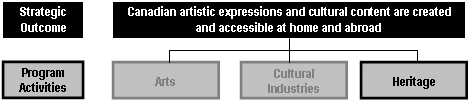
Program Activity Summary
This program activity promotes access to Canada’s heritage, the preservation and protection of items of historical and heritage significance, and the sustainability of organizations that preserve and present Canadian heritage. This is accomplished by providing funding as well as capacity-building resources and services to the heritage community, to support the preservation and protection of heritage collections and objects, and to facilitate the creation and presentation of exhibitions and other forms of heritage content. The objectives are to improve Canadians’ access to diverse, quality heritage products and experiences, and to provide youth employment opportunities in the heritage fields.
|
Sub-activities |
3.1 Museums Assistance Program 3.2 Canada Travelling Exhibition Indemnification Program 3.3 Canadian Heritage Information Network 3.4 Canadian Conservation Institute 3.5 Movable Cultural Property Program |
Benefits for Canadians
Cultural heritage reflects and defines our sense of Canadian identity. The opportunities provided by museums and other heritage institutions encourage the discovery of the rich diversity of Canada’s history and culture and strengthen the bonds between our past, our present and our future in an increasingly pluralistic society.
Museums and other heritage organizations have important roles in preserving the past and providing learning opportunities; they constitute highly trusted sources of information. Heritage institutions also play an important role in attracting tourists in all regions and in both large and small communities, thus contributing to the economic development of these communities.
The programs and services offered by the Department assist heritage institutions to improve their knowledge, skills and practices, to preserve their collections and to make Canadian and international heritage available to the public.
Planning Highlights
To achieve the expected results, the Department of Canadian Heritage plans to undertake the following activities:
- The Department will move forward with the review of the Cultural Property Export and Import Act, as announced in July 2007, to ensure that it remains as effective as possible in the protection of Canadian and international heritage. Building on the consultations conducted in 2008–2009, the Department will formulate recommendations to the Minister regarding
legislative changes that may be necessary.
- The Department will propose a strategy for the Canada Travelling Exhibitions Indemnification Program (CTEIP) to address the impact of higher exhibition values. Through the CTEIP, the Government assumes financial liability for loss or damage to objects in eligible travelling exhibitions, thus contributing to increased access by Canadians to Canadian and world heritage.
- The Department will also undertake other initiatives for the continued enhancement of programs and services that contribute to the preservation of heritage collections and that support access to heritage. For instance, the Virtual Museum of Canada will be redesigned and the Canadian Conservation Institute and the Canadian Heritage Information Network will enhance the learning opportunities they provide.
| Performance Measurement Framework | |||||
|---|---|---|---|---|---|
| Expected Results: | Performance Indicators: | ||||
| Heritage institutions and heritage workers have improved their professional knowledge, skills and practices. | Improvement in professional knowledge, skills and practices reported by participants in learning opportunities provided by the Heritage Group, including online learning materials, publications, training and financial assistance. | ||||
| Heritage collections are preserved by heritage institutions for current and future generations. | Number of heritage collections and objects (artifacts and works of art) whose preservation has been supported by program interventions (expert services, export regulation, direct and tax-based financial support). | ||||
| Canadian and international audiences access content presented by heritage institutions. | Number of visits/visitors to travelling exhibitions and online exhibitions and other digital heritage content. | ||||
| Financial Resources ($ millions) | Human Resources (Full-time Equivalents) | ||||
|
2009-2010 |
2010-2011 |
2011-2012 |
2009-2010 |
2010-2011 |
2011-2012 |
|
36.8 |
37.0 |
35.4 |
191.9 |
191.9 |
191.9 |
SECTION II -Analysis of Program Activities by Strategic Outcome
Strategic Outcome 2
Canadians have a sense of their Canadian identity
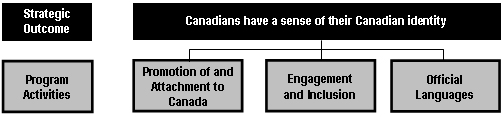
This strategic outcome asserts the need for Canadians of all origins (as members of communities and society) to connect with one another, to better understand their country and its basic shared values, and to come together and celebrate as contributors to Canadian society, thereby strengthening their sense of Canadian identity.
The strategic outcome also suggests that this identity arises out of a knowledge of Canadian political and social history, the conduct of national ceremonial activities, active citizen participation in the civic and cultural life of Canadian communities – including opportunities for shared celebration and commemoration – and measures taken to improve social cohesion and
socio-economic inclusion.
Performance indicators
- Level of appreciation by Canadians of Canadian shared values
- Level of active participation by Canadians in their society
Program Activity 4: Promotion of and Attachment to Canada
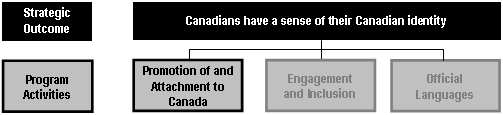
Program Activity Summary
This program activity promotes Canadian identity through building trust, pride and a sense of national purpose in Canadians. It represents and celebrates Canada to Canadians and to the world, showcasing ingenuity, achievements, innovations, excellence and leadership; expresses shared values, cultural diversity and place in the global community. It also promotes civic education, participation among young Canadians through exchanges, forums and community service, as well as provides them with the opportunity to learn about and understand Canada’s society, diversity, history and institutions.
|
Sub-activities |
4.1 Celebration and Commemoration Program 4.2 State Ceremonial and Protocol 4.3 International Expositions 4.4 Canadian Studies Program 4.5 Exchanges Canada Program 4.6 Katimavik Program |
Benefits for Canadians
Through a fostering of Canadian identity and belonging that includes Canadians from all backgrounds, Canada’s social foundations are strengthened. The programs offer Canadians the opportunity to learn about our history, civics, symbols and institutions, and to participate in events of national significance. They enable Canadian youth to connect with one another, explore Canada’s diversity, understand their roles as citizens and actively engage in their communities and country. Together, they administer activities that promote attachment to Canada and provide a platform to showcase Canadian culture, talent and innovation to the world.
Planning Highlights
To achieve the expected results, the Department of Canadian Heritage plans to undertake the following activities:
- The Department will deliver a national engagement strategy for the 2010 Olympic and Paralympic Winter Games to bring Canadians together and to raise awareness of Canada abroad by supporting the Opening Ceremonies for the 2010 Games, enhancing the Torch Relays with community events, and supporting the Celebration Sites in Vancouver and Whistler.
- The Department will complete Canada’s preparation for participation in Expo 2010 in Shanghai, China, including pavilion construction, programming and outreach.
- The Department will continue to deliver policies and programs that promote civic education and participation among young Canadians, such as Canadian Studies, Katimavik, and Exchanges Canada. These programs and policies will be updated as needed to maximize benefits for Canadians. For instance, the Department will provide enhanced funding through the Canadian Studies Program to strategic partners to support the creation of innovative learning materials.
| Performance Measurement Framework | |||||
|---|---|---|---|---|---|
| Expected Results: | Performance Indicators: | ||||
| Knowledge of and appreciation for Canada’s shared values and common interests by Canadians, particularly youth, and by the international community. | Number and rate of Canadians reached by PCH initiatives who report increased level of awareness, knowledge of and appreciation for Canada's values and culture. | ||||
| Extent of international recognition for Canada’s values and common interests. | |||||
| Percentage of Canadians reached by activities, events, commemorations and exhibits. | |||||
| Financial Resources ($ millions) | Human Resources (Full-time Equivalents) | ||||
|
2009-2010 |
2010-2011 |
2011-2012 |
2009-2010 |
2010-2011 |
2011-2012 |
|
131.3 |
71.2 |
67.4 |
129.1 |
112.4 |
112.4 |
PROGRAM ACTIVITY 5: ENGAGEMENT AND INCLUSION
Program Activity Summary
Canada's ability to leverage the benefits of diversity depends on its success at ensuring that Canadians are engaged and have the opportunity to participate in the economic, social, political and cultural aspects of Canadian society. Through different initiatives, this program activity also fosters increased intercultural understanding and works toward the goal that Canadians live in a society where they are treated fairly and equitably, regardless of their background.
|
Sub-activities |
5.1 Multiculturalism Program* 5.2 Action Plan against Racism* 5.3 Human Rights Program 5.4 Building Communities through Arts and Heritage Program 5.5 Aboriginal Peoples’ Program 5.6 Historical Recognition Program* |
Benefits for Canadians
Canadians are engaged and have the opportunity to participate in the social, cultural and civic life of their communities and country. The programs in this area contribute to the celebration and preservation of local arts and heritage and emphasize inclusiveness as a key to Canadian identity, including strengthened Aboriginal cultural identity and participation in Canadian society.
Planning Highlights
To achieve the expected results, the Department of Canadian Heritage plans to undertake the following activities:
- The Department will continue the implementation of the Building Communities through Arts and Heritage Program (BCAHP), The BCAHP was created to help Canadians celebrate their communities’ past history and present accomplishments. It will increase opportunities, through festivals or other events and activities, for local artists and artisans to be involved in their community and for local groups to commemorate their local history and heritage.
- The Department will coordinate Canada’s response to the United Nations Human Rights Council following the February 2009 Universal Periodic Review. This will contribute to the Department’s ongoing efforts to enhance respect for and the effective domestic implementation of the international human rights treaties to which Canada is a party.
- The Department will continue to deliver the Aboriginal Peoples’ Program (APP). Through its programs, the APP will continue to help Aboriginal peoples to address the social, cultural, and economic issues affecting their lives, and to strengthen their culture.
| Performance Measurement Framework | |||||
|---|---|---|---|---|---|
| Expected Results: | Performance Indicators: | ||||
| Canadians of various backgrounds, reached with PCH initiatives, are engaged and have the opportunity to participate in social, cultural, political and economic aspects of Canadian life. | Level of engagement and participation in social, cultural, and economic aspects of Canadian life by Canadians of various backgrounds (measured through results achieved through specific interventions). | ||||
| Financial Resources ($ millions)* | Human Resources (Full-time Equivalents)* | ||||
|
2009-2010 |
2010-2011 |
2011-2012 |
2009-2010 |
2010-2011 |
2011-2012 |
|
131.7 |
119.3 |
113.4 |
251.7 |
241.3 |
241.2 |
PROGRAM ACTIVITY 6: OFFICIAL LANGUAGES
Program Activity Summary
Canadian Heritage is responsible for the planning, implementation and management of the Official Languages Support Programs pertaining to the promotion of linguistic duality within Canada and the development of official-language minority communities, in accordance with Canadian Heritage’s mandate pursuant to article 43 of the Official Languages Act. Canadian Heritage plays a coordination and support role among federal institutions in the implementation of their commitment to the development of official-language minority communities and to the promotion of linguistic duality, as conferred by article 42 of the Official Languages Act. Canadian Heritage is also responsible for the horizontal coordination of the Official Languages Program (OLP) covering all activities of federal institutions subject to the Official Languages Act, including language of service or of work, support for linguistic duality within Canada and support for the development of official-language minority communities.
|
Sub-activities |
6.1 Development of Official-Language Communities Program 6.2 Enhancement of Official Languages Program 6.3 Official Languages Coordination Program |
Benefits for Canadians
Canadians enjoy the benefits of linguistic duality to live and work in communities that reflect Canadian values with respect to the use of English and French, and have access to government services in the language of their choice. This is accomplished through enhancing the capacity of Canadians living in official-language minority communities to live and work in the language of their choice, through increasing the proportion of Canadians who are aware of the benefits and have the necessary tools to appreciate linguistic duality and through strengthening the capacity of the Government of Canada relating to official languages. More precisely, Canadians will benefit from a range of actions in the areas of health, immigration, justice, economic development, and arts and culture.
Planning Highlights
To achieve the expected results, the Department of Canadian Heritage plans to undertake the following activities:
- In collaboration with thirteen federal departments and agencies, the Department will move forward with the implementation of the Roadmap for Canada’s Linguistic Duality 2008–2013, a $1.1 billion investment over five years. Canadian Heritage is playing a coordinating role in addition to being responsible for implementing new initiatives such as the National Translation Program for Book Publishing, Music Showcases for Artists from Official Language Minority Communities, and a Cultural Development Fund.
- The Department will also implement the new Language Rights Support Program, which will encourage language disputes to be resolved through mediation and will support complainants in cases that may further constitutional language rights.
- The Department will renew federal‑provincial agreements and collaboration accords with official‑language minority communities. The aim of these agreements is to set out a framework for the financial support granted to official‑language minority community organizations and the provinces and territories under the Official Languages Support Programs to provide government services in the minority language, fund minority school boards and teach English and French as a second language.
| Performance Measurement Framework | |||||
|---|---|---|---|---|---|
| Expected Results: | Performance Indicators: | ||||
| Canadians recognize and support linguistic duality. | Recognition by Canadians of the benefits of linguistic duality. | ||||
| Members of official-language-minority communities can live in their language, in their communities. | Satisfaction of official-language minority communities with access to programs and services provided by community organizations, and provincial, territorial and local governments. | ||||
| Official-language minority communities confidence regarding enhancement of their community. | |||||
| Financial Resources ($ millions) | Human Resources (Full-time Equivalents) | ||||
|
2009-2010 |
2010-2011 |
2011-2012 |
2009-2010 |
2010-2011 |
2011-2012 |
|
375.2 |
363.7 |
348.5 |
130.0 |
131.3 |
131.3 |
SECTION II -Analysis of Program Activities by Strategic Outcome
Strategic Outcome 3
Canadians participate and excel in sport
This outcome speaks to the beneficial effects of sport participation on the health and well-being of individuals, on the cohesion of communities, and on Canadians’ pride in their country. To this end, it portrays a spectrum of sport participation from playground to podium, and recognizes the inspirational value of sporting excellence in Canadian life, as well as the regard in which world-class Canadian athletes are held at home and abroad. It asserts the importance of sport to Canadian identity. It also speaks to the importance of the sport system at all levels, enabling sport participation by Canadians and, at the same time, fostering the development of high-performance athletes, coaches, and officials. This system includes national sport organizations and sport facilities throughout the country, and contributes directly to the capacity of Canadian communities to host the Canada Games and international sport events, which in turn further enhance Canada’s sport system and international sporting reputation.
Performance indicators
- Rate, frequency and nature of participation by Canadians in sport activities
- International ranking at Olympic/Paralympic Games and World Championships
Program Activity 7: Sport

Program Activity Summary
This program activity promotes development and excellence in sport among Canadians and within Canadian communities. This is accomplished through support for high-performance athletes in national and international sporting events, enhancing Canada’s ability to host national and international sporting events and supporting the development of excellence in coaching and sport organizations. In recent years this program activity has been expanded to include promoting participation in sport by Canadians of all ages and abilities. This program activity provides funding, expertise and other services to Canadian athletes, sports organizations and event organizers.
|
Sub-activities |
7.1 Hosting Program 7.2 Sport Support Program 7.3 Athlete Assistance Program 7.4 2010 Federal Secretariat |
Benefits for Canadians
Sport is important to Canadians. It has the ability to engage citizens, build strong communities and improve the health of Canadians of all ages. Sport contributes to social cohesion and helps to surmount social barriers. It also contributes to national pride as Canadians celebrate the achievements of our athletes at Olympic and Paralympic Games. Sport enriches Canada’s cultural life, promoting Canadian values domestically and internationally and it contributes to economic development and prosperity.
In this area, the government works at home and abroad to promote development and excellence in sport among Canadians and Canadian communities. A highlight of this year will be the hosting of the 2010 Olympic and Paralympic Winter Games in Vancouver and Whistler in February and March 2010.
Planning Highlights
To achieve the expected results, the Department of Canadian Heritage plans to undertake the following activities:
- Sport Canada will develop a framework for athlete development. The objective of the Framework is to focus on the growth, maturation and development of athletes. It identifies the needs of athletes at various stages of their development, including needs relating to coaching, training, equipment, and competition.
- The Department will work to finalize the new Policy and Action Plan on Sport for Women and Girls, which will reaffirm the Government’s commitment to women in sport and will provide direction for programs and activities.
- The Department will continue to work towards the successful hosting of the 2010 Olympic and Paralympic Winter Games in Vancouver and Whistler. The 2010 Olympic and Paralympic Winter Games Federal Secretariat is working in a collaborative manner with its 2010 Winter Games partners and other federal departments and agencies to ensure seamless delivery of federal essential services for 2009–2010.
| Performance Measurement Framework | |||||
|---|---|---|---|---|---|
| Expected Results: | Performance Indicators: | ||||
| The sport system provides benefits for Canadians. | Sport development opportunities provided by the Canadian sport system. | ||||
| Financial Resources ($ millions) | Human Resources (Full-time Equivalents) | ||||
|
2009-2010 |
2010-2011 |
2011-2012 |
2009-2010 |
2010-2011 |
2011-2012 |
|
197.3 |
177.9 |
171.3 |
180.3 |
161.2 |
147.7 |
Strategic Outcome
The following program activity supports all strategic outcomes within this organization.
PROGRAM ACTIVITY 8: Internal services
Program Activity Summary
Internal Services are groups of related activities and resources that are administered to support the needs of programs and other corporate obligations of an organization. These groups are: Management and Oversight Services; Communications Services; Legal Services; Human Resources Management Services; Financial Management Services; Information Management Services; Information Technology Services; Real Property Services; Materiel Services; Acquisition Services; and Travel and Other Administrative Services. Internal Services include only those activities and resources that apply across an organization and not to those provided specifically to a program.
|
Sub-activities |
8.1 Governance and Management Structure 8.2 Resource Management Services 8.3 Asset Management Services |
Planning Highlights
The Management Accountability Framework (MAF) sets out the Government’s expectations for good management of a department or agency. The annual assessment process, performed by central agencies, informs the development of a departmental action plan that strategically supports the continuous improvement of the organization’s management capacity. The resulting strategies and actions contained in the action plan align to support the three departmental management priorities identified in Section I (integration of financial and non-financial information, Blue Ribbon Panel, and Public Service Renewal).
| Financial Resources ($ millions) | Human Resources (Full-time Equivalents) | ||||
|---|---|---|---|---|---|
|
2009-2010 |
2010-2011 |
2011-2012 |
2009-2010 |
2010-2011 |
2011-2012 |
|
87.7 |
77.1 |
79.3 |
1,016.8 |
953.9 |
967.9 |
SECTION III – Supplementary Information
List of Tables
The following tables are located on the Treasury Board Secretariat website, at http://www.tbs-sct.gc.ca/rpp/st-ts-eng.asp :
Details on Transfer Payment Programs
Up-Front Multi-Year Funding
Green Procurement
Sustainable Development Strategy
Horizontal Initiatives
Internal Audits
Evaluations
Sources of Respendable and Non-Respendable Revenue
Other Items of Interest
Legislation related to Canadian Heritage
Portfolio Crown corporations and other organizations
Regional offices