This guide:
- reflects best practices in real property portfolio management
- supports the development, implementation and monitoring of a real property portfolio strategy, as set out in subsections 4.1.4 and 4.2.5 of the Treasury Board Directive on the Management of Real Property
Custodians:Footnote 1
- are responsible for the administration of federal real propertyFootnote 2
- may adjust their approach to portfolio management to align with their structure and operational context
The full technical guide to portfolio management and real property portfolio strategies can be obtained by contacting the Investment Management Directorate at TBS-SCTInvestmentManagement-Gestiondesinvestissements@tbs-sct.gc.ca.
Custodians are required to:
- develop, implement and monitor a real property portfolio strategy
- use this strategy when making investment decisionsFootnote 3
A real property portfolio strategy is a strategic planning document that:
- has a planning horizon of at least 10 years
- looks beyond singular assets
- sets the direction for how the real property portfolioFootnote 4 will be intentionally and proactively managed to support:
- the custodian’s mandate, strategic business objectives and forward-looking program requirements
- the Government of Canada’s priorities for real property and socio-economic and environmental outcomes (for example, greening government operations)
- sound stewardship and best value to the Crown
Using evidence-based analysis, a real property portfolio strategy:
- assesses the current state of the portfolio
- describes the desired future state of the portfolio
- identifies financial and non-financial risks and resource gaps associated with achieving the desired future state
- charts a strategic road map for the portfolio as it evolves and responds to program needs, the Government of Canada’s broader objectives and the context of corporate real estate
Deputy heads are responsible for compliance with Treasury Board policies, including designating a senior officialFootnote 5 or senior officials responsible for the management of real property and the development, implementation, and monitoring of a real property portfolio strategy.Footnote 6
Federal real property is a strategic platform that supports custodians in delivering mandated programs and services to Canadians. To meet the requirements set out in subsections 4.1.1.4 and 4.1.1.5 of the Directive on the Management of Real Property, and as a best practice, there should be a consultation on a real property portfolio strategy. In addition to the consultation, the strategy should be communicated internally by the custodian and endorsed by an appropriate governance body (for example, a senior advisory board) at the assistant deputy minister level. This governance body should include the senior designated official or officials for the management of real property and key stakeholders, including the chief financial officer and senior officials responsible for the delivery of programs and services.Footnote 7 The development of the portfolio strategy should integrate and reflect the feedback and decisions made by the appropriate governance body or senior advisory board.
Portfolio management:
- is the ongoing process of aligning the real property portfolio with strategic priorities and forward‑looking program requirements while considering risks and resource constraints
- overcomes geographic and functional silos through central oversight of the performance of the portfolio and its related investments
The foundation of a real property portfolio strategy rests on five principles of portfolio management. The way in which these principles are applied may be tailored to suit a custodian’s specific operational context.
3.1 Enable strategic objectives and contribute to government priorities
Real property supports the delivery of programs and services to Canadians and enables the advancement of broader strategic objectives (for example, achieving net-zero carbon operations and contributing to climate resilience, furthering Indigenous reconciliation, driving digital transformation, improving accessibility, conserving heritage value and stimulating the economy).
3.2 Use information management
Comprehensive, reliable and current information on real property assets and the use of an information management system to facilitate data analysis are the backbone of evidence-based portfolio management.
3.3 Analyze segments, not just individual assets
Similar assets are considered together to allow for a higher-level perspective of the portfolio, typically organized by function, asset type, priority and location. This higher-level perspective promotes the discovery of opportunities within and between segments, such as consolidation, resource-sharing, talent mobility, collaboration across government and economies of scale.
3.4 Use life-cycle costing techniques
Real property decisions must be based on an assessment of full life-cycle costs. Life-cycle costing is a logical, systematic process for estimating the total cost of real property through its whole life from the initial planning to acquisition, use and disposal.Footnote 8
3.5 Highlight areas of risk
Risk management involves identifying, balancing, and mitigating internal and external risk factors (environmental, legal, operational, reputational and financial) to effectively realize the outcomes that are expected from the real property portfolio.Footnote 9
The portfolio management process consists of seven broadly defined steps, which can be undertaken concurrently, and which are illustrated in Figure 1.Footnote 10 The appropriate governance body or senior advisory board should be engaged during each of the seven steps as their role is to allow for input, internal challenge, decision-making and endorsement from the custodian’s internal functions.
4.1 Understand the current state of the portfolio (the supply)
Determine how the portfolio is performing using performance indicators and benchmarks. Monitor the functionality, utilization, and physical, environmental and financial performance of real property assets over their life-cycle.
4.2 Facilitate the development of a portfolio vision
Describe the desired state of the portfolio and include strategic objectives and priorities, such as achieving net-zero operations. Senior officials responsible for the delivery of programs and services should be involved in the development of the portfolio vision by participating in strategic planning discussions with the appropriate governance body or senior advisory board. The vision guides decision‑making for the rest of the portfolio management process.
4.3 Understand the requirements of the real property portfolio (the demand)
Enable informed and integrated real property management decisions through collaboration between real property officials and program leads. Analyze and forecast demand over time by looking for new ways to support the portfolio vision, including solutions that may not involve real property.
4.4 Compare and analyze supply and demand
Assess the current supply against demand, which includes the portfolio vision, to inform resourcing and sequencing decisions, as well as the investment plan. Consider the results from an environmental scan (for example, market conditions, inflation rates, availability of labour and services, and supply chains).
4.5 Explore options to close the gap between supply and demand
Conduct a gap analysis and explore the most effective ways of optimizing the portfolio while minimizing the gap between supply and demand. Evaluate trade-offs to minimize the gap while respecting resource constraints and risk tolerances. Fully account for the financial and non-financial resources that are committed to the portfolio, including the human resources, contracted real property services and sources of funds (including any spending constraints).
4.6 Prepare the real property portfolio strategy and the portfolio implementation plan
The real property portfolio strategy helps decision-makers and stakeholders understand what the portfolio will achieve in the longer term and how strategic objectives will be met. It covers a planning horizon of at least 10 years and includes a shorter-term, 5-year portfolio implementation plan.
The portfolio strategy includes:
- an overview of the real property portfolio and its performance
- a summary of demand, including the portfolio vision
- a description of the gap between supply and demand and the plan to close the gap
- a summary of planned, low-risk investments and significant investmentsFootnote 11
- a summary of how socio-economic priorities are addressed (for example, accessibility and heritage conservation), including how the commitments in the Greening Government Strategy will be metFootnote 12
- the financial and non-financial resources needed to support and maintain the portfolio
- a risk assessment
- key performance indicators and targets
- a five-year implementation plan
The five-year implementation plan details planned investments. It includes a delivery schedule, specific financial and non‑financial resource allocations, and key interdependencies. The implementation plan is used in the investment planning process.
For more information on the contents of the real property portfolio strategy, see “Contents of the real property portfolio strategy.”
4.7 Implement and monitor the approved plan
Implementation refers to the delivery of the implementation plan. Monitoring ensures that progress is regularly assessed and reported against a baseline. Monitoring keeps implementation on track and makes visible whether the real property portfolio is delivering on expected results.Footnote 13
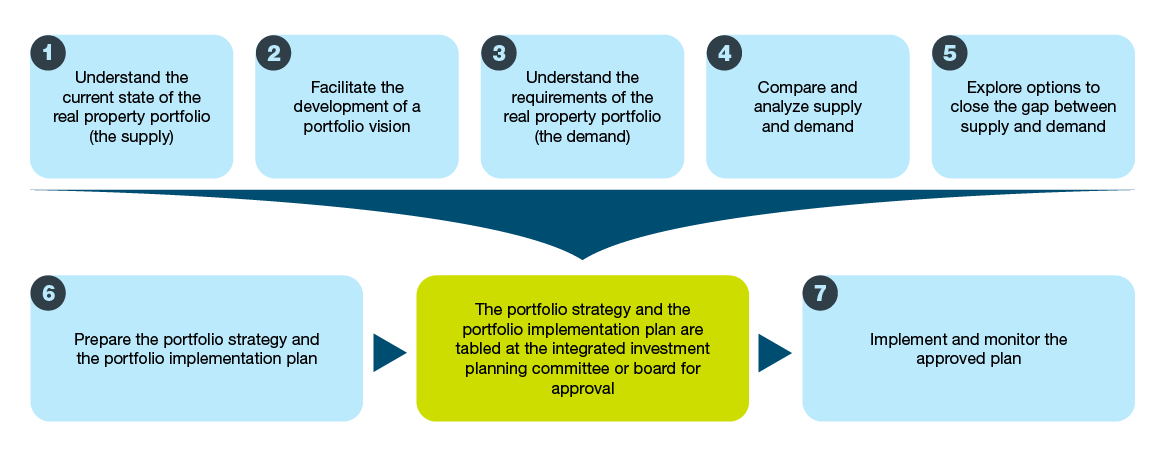
Figure 1 - Text version
Figure 1 shows the seven steps in the portfolio management process:
- Understand the current state of the real property portfolio (the supply)
- Facilitate the development of a portfolio vision
- Understand the requirements of the real property portfolio (the demand)
- Compare and analyze supply and demand
- Explore options to close the gap between supply and demand
- Prepare the portfolio strategy and the portfolio implementation plan
- Between steps 6 and 7, the portfolio strategy and the portfolio implementation plan are tabled at the integrated investment planning committee or board for approval
- Implement and monitor the approved plan
This section outlines what custodians should include in a real property portfolio strategy.
Table of contents
It is helpful to include a table of contents.
Executive summary
The executive summary gives readers the essence of the document. They should be able to read only the executive summary and know basically what the document contains.
Introduction
The introduction outlines the contents of the document.
It can explain what a real property portfolio strategy is and describe its purpose.
It can also indicate:
- how the strategy will help address gaps in the portfolio and policies and priorities influencing the management of the real property portfolio
- how it will help achieve expected policy results and government‑wide priorities
Methodology
This section explains how the real property portfolio strategy was developed.
Custodians that have not yet developed a real property portfolio strategy must use this section to outline their plan for developing one, including timeframes and key milestones.
Current portfolio
This section describes the current real property portfolio (the supply).
It is informed by documents such as:
- asset condition reports
- asset management plans
- environmental reports
- financial reports
The description should include the following information about the current portfolio:
- size
- estimated replacement value
- composition (asset types, for example, laboratory, warehouse, general purpose office space)
- asset mix (for example, the ratio of Crown-owned assets to leased assets)
- environmental performance, greenhouse gas (GHG) emissions, climate risk and resilience
- utilization
- functionality
- physical condition, including average age
- number and status of surplus assets
- financial performance, including annual expenditures to maintain the portfolio (for example, operations and maintenance, capital and payment in lieu of taxes), and financial liabilities (for deferred maintenance, for example)
Portfolio vision
This section describes the desired future state of the portfolio. It can include strategic objectives and priorities that will help focus and guide decision-making throughout the portfolio management process.
Objectives and priorities could relate to:
- new or existing mandates and policies
- forward‑looking program requirements
- furthering Indigenous reconciliation
- demonstrating leadership in the fight against climate change, including net-zero operations and enhancing climate resilience
- improving accessibility
- increasing diversity, including diversity in gender identity and gender expression
- conserving heritage value
- supporting digital transformation
- promoting economic growth and capacity development
- increasing the local supply of affordable housing
- supporting educational development in communities
- promoting the use of shared facilities within the federal government and in communities where the federal government operates
Portfolio demand requirements
This section describes what is required to support achieving the portfolio vision.
Possible topics to cover:
- asset types (for example, laboratory, storage, special‑purpose space)
- information management and information technology (IM/IT)
- physical security
- IT security
- materiel
- human resources required to manage the portfolio
Supply and demand gap analysis: key challenges and risks
This section:
- analyzes the gap between supply and demand
- identifies any significant challenges or risks associated with closing the gap
- makes recommendations to address these risks
The following are examples of challenges or risks:
- funding pressures
- human resource pressures
- challenging market conditions
- risks associated with achieving a net-zero portfolio by 2050 and risks associated to climate change impacts
- challenges associated with right‑sizing the portfolio footprint
- long lead times for real property disposals and acquisitions
Portfolio optimization
This section explains how the custodian plans to:
- optimize portfolio performance
- address the gap between supply and demand
- respond to the challenges and risks identified in the supply and demand gap analysis section
This section could include the following:
- a summary of the planned, low-risk investments and a more detailed summary of the significant investments (in other words, complex, high‑risk, sensitive or extraordinary investments) that should be brought to the attention of the deputy head and the Treasury Board of Canada Secretariat
- a summary of how the current Greening Government Strategy requirements will be met (including how the custodian’s planned actions will help achieve a net-zero, climate-resilient real property portfolio)
- an overview of how the custodian will address the government’s environmental compliance priorities (for example, priorities relating to contaminated sites, potable water, asbestos, radon)
- an overview of how the portfolio strategy will help achieve the government’s socio-economic priorities (for example, accessibility, heritage conservation, Indigenous interests)
- a disposal strategy for all assets identified as surplus or in critical condition that have more than five years of useful life remaining
- a high-level summary of the financial and non‑financial resources needed to implement the real property portfolio strategy
- the estimated target rate of reinvestment to maintain the portfolio in an acceptable condition and to address any deferred maintenance
Implementation plan
This section contains the five-year plan for how the strategy will be implemented.
It contains a delivery schedule and details on:
- short-term investments and activities
- planned allocations for financial, material, IM/IT and human resources
- procurement methods
- risks, challenges and resource shortfalls
Performance measurement and reporting
This section lists the key performance indicators (KPIs) and targets that will be used to measure the success of the portfolio strategy and implementation plan.
Targets must:
- be specific and measurable
- be informed by baseline data
- fall within the custodian’s accountabilities
This section should also describe:
- how KPIs will be measured
- how often
- who the KPI results will be reported to
Monitoring
This section describes the process and frequency for monitoring the implementation of the real property portfolio strategy and for updating it.