The objective of the classification system is to provide information for
multiple uses both within and outside departments. The classification of
accounts provides the framework to identify, aggregate, and report financial
transactions for planning, resource allocation, management control, accounting,
statistical, and evaluation purposes.
To meet financial information requirements, government policy requires
departments to:
- use a four-way classification of transactions--by authority, purpose,
responsibility and object.
- relate their transactions to the uniform government-wide classification
maintained by the Receiver General for objects and for programs activities.
- identify their internal transactions
This policy applies to all organizations considered to be departments within
the meaning of section 2 of the Financial Administration Act (FAA).
- Classification of Transactions
- For financial transactions, the departmental classification of accounts
must be a fourfold classification by:
- authority, to identify the Parliamentary appropriation vote or other
statute under which the transaction was undertaken;
- purpose, to relate the transaction to the departmental objectives by
program and activity;
- responsibility, to identify the organizational unit that is responsible
and accountable for the transaction; and
- object, to identify the type or nature for an expenditure, the source for
any revenue, or the cause of the increase or decrease for financial claims
and obligations.
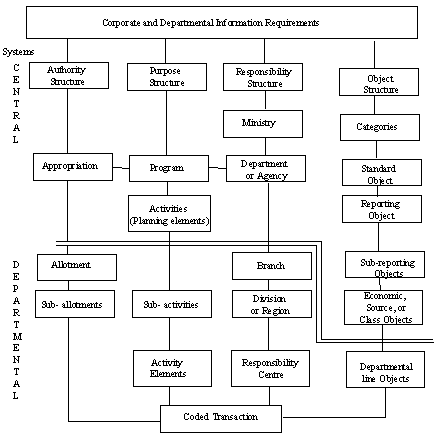
The relationship between the four classification structures is depicted in
Appendix A.
This four-fold classification structure is linked through an integrated but
mutually exclusive coding system which requires each transaction to be
identified in terms of each classification. This allows subsequent retrieval and
analysis of financial data by separate categories.
These classifications are explained briefly in Appendix B and in more detail
in Chapter 3 of the Chart of Accounts Volume, which is a supplementary volume to
the Comptrollership Volume of the Treasury Board Manual.
- Departmental programs and activities must be related to the
government-wide list of programs and activities in the program and activity
classification prescribed by the Treasury Board.
The government-wide list of programs and activities is included in section
6.2 of the Chart of Accounts Volume. The classification has been derived from
the programs and activities included in Part II of the Main Estimates for the
current fiscal year.
- Departmental objects must be related to the government-wide objects in the
object classification prescribed by the Treasury Board.
The government-wide object classification is in the Master List of Objects
included in Section 8.2 of the Chart of Accounts Volume.
- To determine and report more accurately the impact of government revenues
and expenditures on the rest of the economy, the net amount of government
purchases and sales by standard object must be determined by identifying
internal transactions so they can be eliminated.
To identify internal transactions properly:
- All departments, including those that use revolving funds, must charge
their expenditures for purchases from outside the government to standard objects
01 to 12. Similarly, sales to entities outside the government must be credited
to standard objects 13 or 14.
- All expenditures relative to purchases from other departments or from
within a department must be charged to standard object 15.
- All revenues from sales to other departments or within a department must
be credited to standard object 16.
The classification system is incorporated as part of the accounting system
and, together with the budgetary process, provides government managers at
various levels with information necessary to manage their policy and control
functions.
The classification of accounts for the Government of Canada is dictated by
the requirements to:
- provide information in a summarized form required for the Accounts of
Canada;
- meet central agency and other requirements for uniform classifications of
data on a government-wide basis, and
- provide summarized and detailed information at the departmental level.
The four classifications required for transactions are explained briefly in
Appendix B, with cross-references provided to where more details can be found in
the Chart of Accounts Volume.
To ensure effective control and for disclosure of information, the
departmental classification of accounts should make provision for recording
assets and liabilities, even though they may not be recorded in the Accounts of
Canada, nor appear in the Statement of Assets and Liabilities of the Government
of Canada.
Additional explanations for the asset and liability classification are
included in Chapter 3 of the Chart of Accounts Volume.
Treasury Board Secretariat
Treasury Board Secretariat (TBS) is responsible for policy development,
advice and interpretation, and implementation assistance including appropriate
training/information sessions for departments, and for promulgating any changes
required to the Chart of Accounts Volume for the Government of Canada.
This includes the annual amendments to the Master List of Objects and Master
List of Programs and Activities which are now included in chapters 8 and 6
respectively of the Chart of Accounts Volume.
Receiver General
The Receiver General is responsible for recording the transactions received
from departments and agencies in the Central Accounting System, processing them
according to the uniform classification prescribed by statute or by Treasury
Board, and providing reports to various users in Parliament, central agencies
and departments. To accomplish this, the Receiver General provides departments
and agencies with any supporting operational instructions, such as Receiver
General Directives, Bulletins and other guidance related to the classification
and coding system.
Departments
Departments are responsible for implementing the four-way classification in
departmental accounts and meeting coding requirements for government-wide
classifications included in the master lists of objects and of programs and
activities. This includes the primary responsibility for ensuring that
appropriate departmental classification changes are made to reflect any changes
in the master lists, for ensuring transactions are coded accurately, and for
monitoring the quality of departmental coding. It is imperative that departments
implement all requirements specified by Treasury Board Secretariat and the
Receiver General to ensure appropriate quality, integrity and timeliness for
government-wide financial information. This includes the need for monthly
reconciliations between classification in the departmental and central
accounting systems.
The internal audit group in each department will include the review of
classification and coding in internal audit plans. The Government Operational
Services Sector of Public Works and Government Services Canada will monitor the
quality of government-wide classifications and coding.
The Treasury Board Secretariat will monitor the overall quality of data in
the CAIS Relational Data Base. However the primary responsibility for the
application of this policy rests with the Senior Full-Time Financial Officer
(SFFO).
This policy is issued by the Treasury Board under the authority of Section
9(1) of the Financial Administration Act.
In implementing this policy departments must refer to the Chart of Accounts
Volume which is a supplementary volume to the Comptrollership Volume of the
Treasury Board Manual.
With the issue of this chapter, and the Chart of Accounts manual, the
following TB circulars are being replaced:
1986-33 Introduction of a Government-wide Purpose Classification by Program
Activity for Budgetary Expenditures
1987-50 Title of Standard Object 12
1987-54 Identification of Internal Transactions within the Government of
Canada
Departments are also referred to the latest Receiver General Directive on the
Reporting and Reconciliation of Government-wide Classifications of Financial
Information.
This chapter cancels chapter 7-1 of the "Financial Management"
volume dated April 1, 1991; and
this policy supersedes chapter 4 of the Treasury Board "Guide on
Financial Administration".
Enquiries concerning this policy should be directed to your departmental
headquarters. For interpretation of this policy, departmental headquarters
should contact:
Government Accounting Policy
Comptroller Sector
Program Branch
Treasury Board Secretariat
Ottawa, Ontario
K1A 0R5
Telephone: (613) 952-3404
Facsimile: (613) 952-9613For information on the Chart of Accounts Volume departmental Headquarters
should contact:
Strategic Information Services
Office of Information Management, Systems
and Technology
Treasury Board Secretariat
Ottawa, Ontario
K1A 0R5
Telephone: (613) 952-3357
Facsimile: (613) 941-0287